Why a Game Tutorial Teaches by Letting You Try
A game tutorial teaches best when it lets you try one low-pressure action first, helping you learn controls through feedback before new rules appear.
A game tutorial teaches a control more clearly when it gives you a safe action to try before explaining the next rule. That small first attempt turns a button prompt into a visible relationship: press, move, see what changed. The design question is not simply how much to explain, but when to let the player act and what the game should do with the result.
There are three useful approaches: a guided action, a quiet practice space, and a challenge that teaches through context. Each can work, but they suit different controls, player expectations, and levels of pressure. The strongest choice is the one that makes the next action understandable without making the player feel examined.
Why does trying a control teach more than reading about it?
A sentence can name an input, but it cannot show the player how that input feels in this particular game. “Press to dodge” leaves open questions about timing, distance, direction, and whether the move interrupts another action. A brief attempt answers some of those questions through animation, sound, and the change on screen.
That feedback also helps players build a usable mental model. They notice that holding a direction changes movement, while tapping a button triggers a distinct action; they can then predict what might happen the next time. The tutorial should let them connect an input to a result before asking them to remember several linked rules.
Low pressure matters because uncertainty is part of learning. If a first mistake costs a life, breaks a long sequence, or draws an enemy’s attack, the player may focus on avoiding punishment rather than understanding the control. A forgiving space lets attention stay on the relationship between action and response.
When is a guided action the best approach?
A guided action gives the player one clear prompt, then waits for an attempt. The game might show a button icon beside a nearby object, pause other threats, or make the relevant target visually distinct. Once the player acts, a short response confirms what happened, and the prompt can move on.
This approach suits controls that are easy to demonstrate and central to the next moment: moving, jumping, interacting, or aiming. It is especially useful when players must learn the game’s particular version of a familiar input. A jump may carry the character farther than expected, for example, or interaction may depend on facing an object.
The prompt should describe an action, not narrate a whole theory. “Press to climb” is easier to use than a paragraph covering climbing, ledge detection, stamina, and route choice before the player has touched the controls. Later rules can arrive when the game gives them a reason to matter.
Guidance can become overbearing if every action is paused for instruction. Keep it for moments when a wrong guess would confuse the player or disrupt the scene; let familiar inputs remain in the player’s hands.
Would a practice space suit this control better?
A practice space lets players repeat an action without immediately advancing through a scene. It might be a quiet corner, a training room, or a stretch of level designed around one mechanic. Unlike a single guided prompt, it offers room to vary timing and direction and notice how the control responds.
This format suits actions with a feel that takes repetition to grasp, such as steering, aiming, chaining moves, or managing a jump’s momentum. The player can compare attempts rather than trying to absorb every detail from a single demonstration. Simple targets and clear feedback make the space useful; decorative clutter and unrelated hazards make it harder to read.
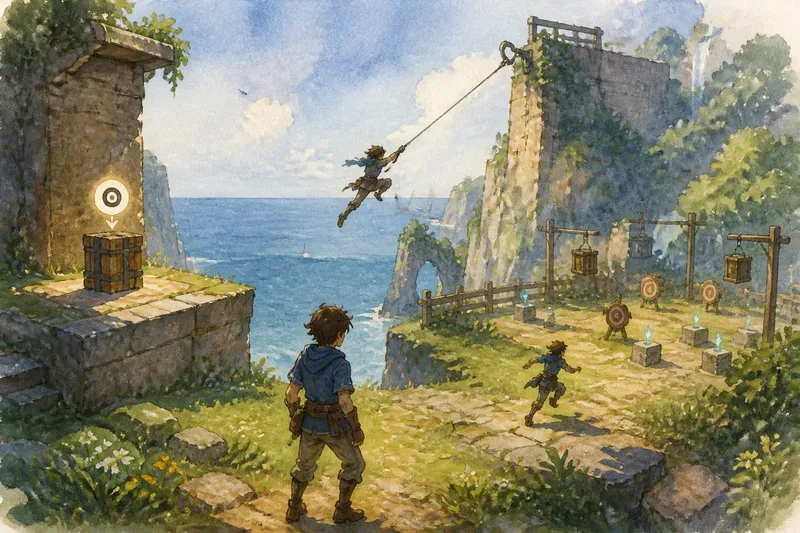
Say a fictional platform game introduces a grappling hook. It places one broad ledge across a safe gap, displays the hook input, and lets the player try again after a miss without losing progress. The expected observable result is that the player can see the hook’s reach and timing through repeated attempts, before the level asks them to use it near a moving hazard.
Practice should still have a purpose. If the player must stay in a room until they satisfy a hidden precision threshold, a forgiving lesson has quietly become a test. Offer an obvious next route, and let players leave when they understand enough to continue.
When can a challenge teach through context?
A contextual challenge introduces a control as part of a meaningful situation instead of isolating it in a lesson area. The player might need to duck beneath a low beam, push an object to reach a ledge, or use a newly introduced move to cross a visible gap. The setting itself helps explain why the action matters.
This approach suits players who prefer to learn while moving through the game, and mechanics whose purpose is clearer in a scene than on a blank screen. It can preserve pace and make a control feel like part of play rather than an interruption. The environment must still signal the useful action clearly enough that the player can make a sensible guess.
Context becomes a poor teacher when several new demands arrive together. If a player is learning a dodge while an enemy attacks, the camera shifts, and a timed gate closes, failure will not reveal which rule they missed. Introduce the control in a readable moment, then combine it with pressure after the player has had a chance to try it.
Which tutorial approach fits your game?
Choose by asking what the player must learn and what a first mistake would cost. A simple input that needs a clear confirmation calls for a guided action; a control with timing or feel to discover calls for practice; a mechanic whose purpose depends on the surroundings may be best introduced in context.
- Choose a guided action when the input is straightforward, the next task depends on it, and one attempt can make the result clear.
- Choose a practice space when players need repeated attempts to learn timing, range, direction, or a combination of inputs.
- Choose a contextual challenge when the environment naturally explains why the action is useful and the scene can stay calm enough to read.
- Delay extra rules when the player has not yet linked the control to its basic result.
- Reconsider the lesson if players cannot tell whether a failed attempt came from the input, the timing, or an unintroduced rule.
These options can also form a progression rather than compete. A game might first cue one action, then offer a safe chance to repeat it, then bring the same control into a more demanding scene. Each new context should add a distinct decision, not merely increase pressure.
What should a tutorial do after the first attempt?
The response to an attempt is part of the lesson. If the player acts correctly, acknowledge the result with a clear animation, sound, or changed state; avoid burying that confirmation beneath fresh instructions. If the action does not work, preserve enough information for the player to try again rather than immediately repeating a long prompt.
Prompts should also adapt to what the player has done. A player who succeeds quickly may need less interruption than someone who hesitates. This does not require guessing at a player’s ability; it means letting the game respond to visible actions, such as whether the requested input has been tried or the target has been reached.
Accessibility belongs in that response, too. Players may use different controllers, remap inputs, or need more time to read a cue. A tutorial should make its prompts legible and consistent, and should not rely on color alone to identify an action. Where available, adjustable timing and input options can make the learning space more accommodating.
How can you tell whether the lesson is clear?
Watch the order of attempts, not just whether a player eventually advances. Do they notice the prompt, try the relevant input, and understand the response? If they repeatedly press the wrong control, the cue may be hard to see; if they use the right input but get an unexpected result, the game may be asking them to infer an unstated rule.
Ask a focused question after the moment, such as what the player thought the control would do or what made the attempt fail. That answer can distinguish a confusing label from a confusing animation or an overly demanding first challenge. It is more useful than asking whether the tutorial was “good,” which invites a broad reaction without locating the snag.
A game tutorial teaches by letting you try when each attempt gives the player readable feedback and enough room to think. Use a guided action for clarity, a practice space for feel, and context for purpose; then introduce pressure only after the control has started to make sense. The practical test is simple: after the attempt, can the player make a more informed next move?